

Digital Holography Market Poised for Rapid Growth with Expanding 3D Imaging Demand
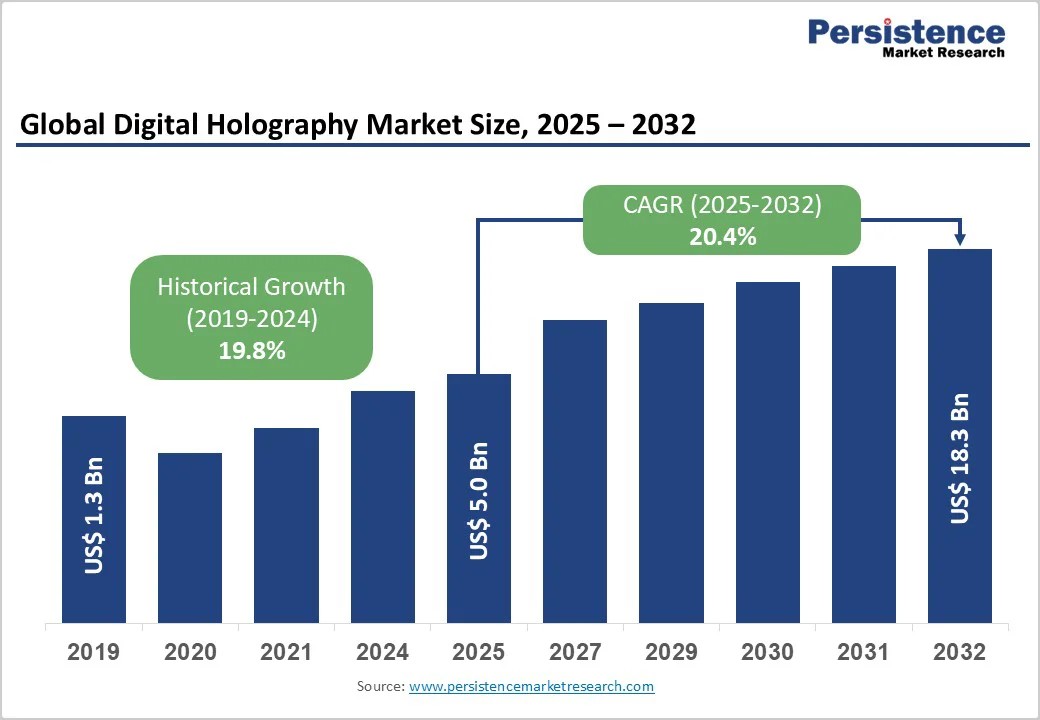
The digital holography market will grow from US$5.0 Bn in 2025 to US$18.3 Bn by 2032, driven by 3D imaging demand and holographic display advances
BRENTFORD, ENGLAND, UNITED KINGDOM, January 30, 2026 /EINPresswire.com/ -- The digital holography market is emerging as a highly transformative segment within advanced imaging and visualization technologies. By enabling the recording, reconstruction, and analysis of three-dimensional images using digital sensors and computational algorithms, digital holography delivers non-contact, non-invasive, and high-resolution visualization. These capabilities make it increasingly valuable across healthcare, industrial inspection, aerospace, defense, and entertainment sectors. As industries demand greater precision and real-time visualization, digital holography is rapidly moving from laboratory research to large-scale commercial deployment.
From a market perspective, the global digital holography market is expected to reach US$5.0 billion in 2025 and expand to US$18.3 billion by 2032, growing at a robust CAGR of 20.4% during the forecast period. Growth is driven by rising adoption of 3D imaging technologies, increasing demand for non-invasive diagnostics, and continuous advancements in holographic displays and optical hardware. Hardware remains the leading segment with nearly 60% market share, while North America leads due to strong R&D investments, and Asia Pacific emerges as the fastest-growing region, supported by expanding healthcare, automotive HUDs, and consumer electronics adoption.
𝐆𝐞𝐭 𝐚 𝐒𝐚𝐦𝐩𝐥𝐞 𝐏𝐃𝐅 𝐁𝐫𝐨𝐜𝐡𝐮𝐫𝐞 𝐨𝐟 𝐭𝐡𝐞 𝐑𝐞𝐩𝐨𝐫𝐭: https://www.persistencemarketresearch.com/samples/14647
Digital Holography Market Segmentation Analysis
The digital holography market segmentation is primarily based on offering type, dimension, application, and end-user industry. Based on offering type, the market is segmented into hardware, software, and services. Hardware dominates the segment due to its critical role in hologram generation, including spatial light modulators, lasers, cameras, and optical components. Continuous innovation in hardware performance, resolution, and miniaturization is reinforcing its market leadership. Meanwhile, software solutions are gaining traction as advanced algorithms enhance image reconstruction, phase analysis, and data interpretation.
From a dimensional perspective, the market is categorized into two-dimensional (2D) and three-dimensional (3D) digital holography. Three-dimensional holography leads the market, accounting for over 70% of revenue, as industries increasingly prioritize depth perception and spatial accuracy. Applications such as holographic microscopy, 3D displays, and augmented reality rely heavily on 3D holographic imaging to deliver immersive and data-rich experiences. The growing preference for 3D visualization across diagnostics, engineering, and entertainment continues to strengthen this segment.
Based on application, the market includes holographic microscopy, holographic displays, metrology and quality control, data storage, and others. Holographic microscopy holds the largest share due to its extensive use in biomedical research, pathology, and life sciences. In terms of end-users, the market serves healthcare, aerospace and defense, automotive, industrial manufacturing, consumer electronics, and entertainment sectors. Among these, healthcare leads adoption, driven by the need for precise, label-free, and non-invasive diagnostic tools.
𝐃𝐨 𝐘𝐨𝐮 𝐇𝐚𝐯𝐞 𝐀𝐧𝐲 𝐐𝐮𝐞𝐫𝐲 𝐎𝐫 𝐒𝐩𝐞𝐜𝐢𝐟𝐢𝐜 𝐑𝐞𝐪𝐮𝐢𝐫𝐞𝐦𝐞𝐧𝐭? 𝐑𝐞𝐪𝐮𝐞𝐬𝐭 𝐂𝐮𝐬𝐭𝐨𝐦𝐢𝐳𝐚𝐭𝐢𝐨𝐧 𝐨𝐟 𝐑𝐞𝐩𝐨𝐫𝐭: https://www.persistencemarketresearch.com/request-customization/14647
Regional Insights and Market Performance
North America dominates the global digital holography market, driven by advanced research infrastructure, early technology adoption, and strong investment in AR/VR and biomedical imaging. The United States, in particular, benefits from a high concentration of holography startups, academic research institutions, and defense-related applications. Strong funding for medical imaging innovation and Industry 4.0 initiatives further supports regional market growth.
The Asia Pacific region is expected to witness the fastest growth during the forecast period, supported by rapid industrialization, expanding healthcare infrastructure, and increasing adoption of consumer holography. Countries such as China, Japan, South Korea, and India are investing heavily in automotive head-up displays (HUDs), smart manufacturing, and medical imaging technologies. Rising awareness of advanced diagnostic solutions and growing AR/VR applications in entertainment are also accelerating demand across the region.
Market Drivers Shaping Industry Growth
One of the primary market drivers for digital holography is the growing demand for high-resolution and non-invasive imaging in healthcare and life sciences. Digital holography enables quantitative phase imaging without the need for dyes or labels, making it highly suitable for live-cell imaging, pathology, and biomedical research. This capability significantly enhances diagnostic accuracy while reducing sample preparation time, driving adoption in hospitals and research laboratories.
Another major driver is the increasing integration of digital holography in metrology, surface inspection, and quality control under Industry 4.0 initiatives. Manufacturers are leveraging holographic techniques for precise measurement, defect detection, and real-time monitoring of components. The ability to perform non-contact inspection with micron-level accuracy is making digital holography indispensable in advanced manufacturing environments.
Market Restraints Limiting Wider Adoption
Despite strong growth potential, the digital holography market faces certain restraints, particularly related to high initial costs and technical complexity. Advanced holographic systems require expensive optical components, high-performance sensors, and computational resources, which can limit adoption among small and medium-sized enterprises. The cost barrier remains a significant challenge, especially in price-sensitive markets.
Additionally, the lack of skilled professionals capable of operating and interpreting holographic systems poses another constraint. Digital holography involves complex optical setups and data analysis processes, requiring specialized training. Limited awareness and standardization across industries further slow adoption, particularly outside established research and industrial hubs.
Emerging Market Opportunities and Future Outlook
The digital holography market presents substantial opportunities driven by the rising demand for non-invasive, label-free imaging solutions in diagnostics and life sciences. As healthcare systems shift toward precision medicine and real-time diagnostics, holographic microscopy and quantitative phase imaging are expected to witness strong demand. These technologies offer unparalleled insights into cellular behavior and disease progression.
Another promising opportunity lies in the expansion of AR/VR and immersive display technologies. Advances in holographic displays are enabling next-generation visualization experiences in gaming, entertainment, education, and defense training. As hardware becomes more compact and cost-effective, digital holography is likely to play a central role in shaping future human-machine interaction and spatial computing applications.
𝐁𝐮𝐲 𝐍𝐨𝐰 𝐭𝐡𝐞 𝐃𝐞𝐭𝐚𝐢𝐥𝐞𝐝 𝐑𝐞𝐩𝐨𝐫𝐭: https://www.persistencemarketresearch.com/checkout/14647
Company Insights
Zebra Imaging
HoloTech Switzerland AG
Lyncee Tec SA
Eon Reality
Holoxica Limited
Geola Digital
Phase Holographic Imaging AB
Related Reports:
Fixed Satellite Services (FSS) Market
Persistence Market Research
Persistence Market Research Pvt Ltd
+1 646-878-6329
email us here
Visit us on social media:
LinkedIn
Instagram
Facebook
YouTube
Legal Disclaimer:
EIN Presswire provides this news content "as is" without warranty of any kind. We do not accept any responsibility or liability for the accuracy, content, images, videos, licenses, completeness, legality, or reliability of the information contained in this article. If you have any complaints or copyright issues related to this article, kindly contact the author above.
