

Asia Pacific Logistics Market is Projected to Grow USD 3,085.62 billion in 2026 to USD 5,581.00 billion by 2035 | MRFR
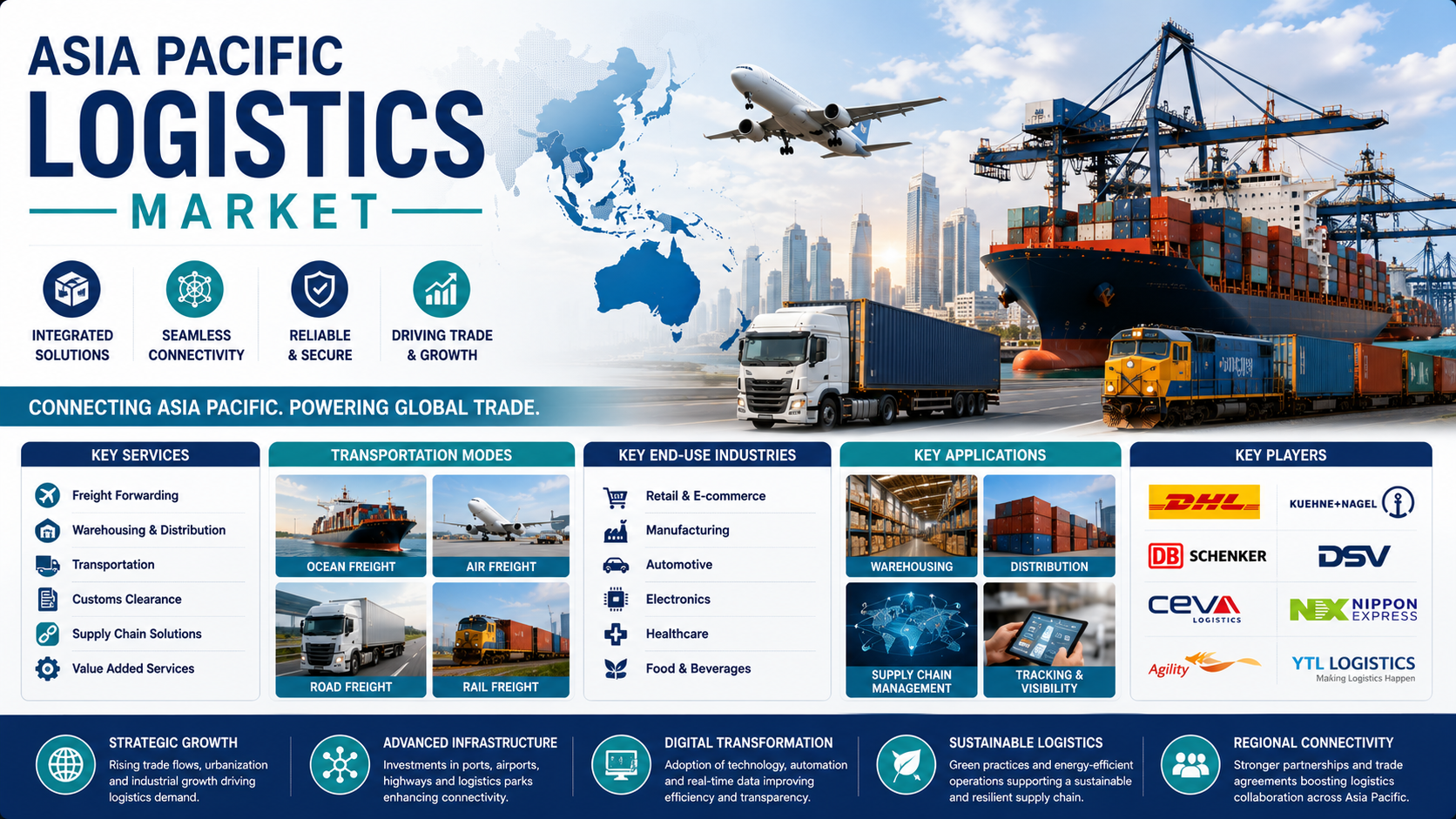
Asia Pacific Logistics Market (2025 - 2035)
Japan contributed roughly 18% of revenue in 2025, supported by high-density urban distribution networks and cold-chain sophistication.
CHINA, JAPAN, July 29, 2026 /EINPresswire.com/ -- The Asia Pacific Logistics Market reached an estimated USD 2,889.16 billion in 2025 and is projected to climb from USD 3,085.62 billion in 2026 to USD 5,581.00 billion by 2035, registering a CAGR of 6.8% across the forecast window. making it one of the more dynamic large-scale logistics markets globally.Growth is being driven by a mix of structural and cyclical forces. Manufacturing supply chains continue to relocate and diversify across the region as companies pursue "China plus one" strategies, spreading production and associated freight demand across Vietnam, India, and other emerging manufacturing hubs. At the same time, e-commerce penetration keeps deepening across both developed markets like Japan and South Korea and fast-growing markets like Indonesia and the Philippines, reinforcing demand for parcel and last-mile delivery infrastructure. Regional trade liberalization, particularly under the Regional Comprehensive Economic Partnership, is also lowering the friction of cross-border freight movement, encouraging more integrated supply chains that span multiple APAC economies.
Key Market Trends
Technology integration is fundamentally reshaping how logistics operations run across the region. Automation, artificial intelligence, and data analytics are increasingly embedded into route planning and warehouse management, streamlining decision-making and improving the agility of supply chains navigating a fast-changing marketplace.
Sustainability has become a parallel priority. Companies across the region are adopting greener practices — from emissions reduction to smarter resource use — as environmental regulations tighten and stakeholders push for more responsible logistics strategies. This shift is influencing capital allocation and operational planning alike.
E-commerce growth continues to be one of the most visible forces reshaping the market. As online shopping expands, logistics providers are adapting to the particular demands of last-mile delivery, investing in urban micro-warehousing and expanded delivery networks to keep pace with consumer expectations for speed and reliability.
Download Report Sample Copy with TOC: https://www.marketresearchfuture.com/sample_request/21466
Market Drivers
Regulatory change is playing a significant role in shaping the region's logistics landscape. The Regional Comprehensive Economic Partnership is expected to lower tariffs and improve trade flows among member countries, which should increase cross-border freight volumes over time. At the same time, stricter emissions and safety standards are pushing logistics companies toward more efficient practices — raising costs in the near term but encouraging longer-term innovation and sustainability gains.
Infrastructure development represents another major growth engine. The Asian Development Bank has projected that infrastructure investment across the region could reach USD 26 trillion by 2030, spanning roads, railways, and ports. Better connectivity and shorter transit times stand to benefit both domestic logistics operations and international trade, ultimately lowering operational costs for market participants.
Technological advancement is also driving efficiency gains. AI-powered route optimization can cut fuel consumption by as much as 20%, offering meaningful cost savings for logistics providers, while blockchain technology is being explored for its potential to strengthen traceability and security across logistics transactions.
Rising consumer expectations continue to push service standards higher. Roughly 70% of consumers in the region now expect their online orders to arrive within two days, a benchmark that is compelling logistics companies to invest in advanced warehousing and last-mile delivery innovations, even as it adds operational complexity.
Investment in green logistics rounds out the driver set. Companies are increasingly adopting electric vehicles and alternative fuels within their fleets, and the broader green logistics solutions market is projected to grow at a CAGR of around 10% over the next five years, as businesses build sustainability into warehousing and packaging decisions to meet both regulatory and consumer demands.
Purchase Now: https://www.marketresearchfuture.com/checkout?currency=one_user-USD&report_id=21466
Market Segmentation
By Logistics Function
Freight transport represents the largest logistics function in the region, reflecting the sheer physical scale of moving goods across APAC's road, rail, sea, and air networks to serve both domestic consumption and export markets. Courier, express, and parcel services form one of the fastest-growing functions, propelled by the region's enormous and still-expanding e-commerce base, which continues to push volumes of smaller, more time-sensitive shipments through last-mile networks. Freight forwarding plays an essential intermediary role, managing the documentation, customs compliance, and multimodal coordination that cross-border trade requires, particularly as regional trade agreements lower tariff barriers and encourage more complex, multi-country supply chains. Warehousing and storage is expanding briskly as well, driven by the need for distribution centers positioned closer to end consumers and by the growing sophistication of cold-chain and bonded-warehouse facilities supporting pharmaceuticals, perishables, and high-value electronics. Other services, spanning customs brokerage, cargo insurance, and value-added packaging and labeling, round out the function-level segmentation, benefiting from the broader trend toward outsourcing non-core logistics activities.
By End-User Industry
Manufacturing is the dominant end-user industry, consistent with APAC's role as the world's factory floor, generating continuous inbound flows of raw materials and components alongside outbound flows of finished goods bound for both regional and global markets. Wholesale and retail trade forms a substantial share as well, propelled by the region's rapidly modernizing retail sector and the logistics complexity of supplying both traditional trade channels and modern e-commerce fulfillment networks. Agriculture, fishing, and forestry contribute a meaningful share of freight volume, particularly in Southeast Asian and South Asian economies where commodity exports such as palm oil, rice, seafood, and timber depend heavily on efficient port and cold-chain logistics. Construction-related freight is expanding steadily, tied to the region's ongoing infrastructure boom and urbanization, which drives demand for the transport of cement, steel, and other bulk building materials. Other industries, including pharmaceuticals, automotive, and electronics manufacturing, represent smaller but often higher-margin verticals, given their more specialized and time-sensitive logistics requirements.
By Freight Transport Mode
Road freight transport holds the largest share among transport modes, given its unmatched flexibility and its central role in last-mile and inland distribution across the region's diverse geography. Sea and inland waterway transport commands a substantial share of the market as well, reflecting APAC's position at the center of global maritime trade and its reliance on major container ports and river-based freight corridors, particularly in China, Southeast Asia, and South Asia. Rail freight is growing steadily as governments across the region invest in new rail corridors and modernize existing lines to shift bulk and long-distance freight away from congested roadways. Air freight, while a smaller share of total volume, continues to be the preferred mode for high-value, time-sensitive goods such as electronics, pharmaceuticals, and e-commerce parcels, and remains an important growth segment given rising express-delivery expectations. Pipeline transport, while narrowly applicable to bulk liquids and gases such as crude oil, refined fuels, and natural gas, remains a stable niche within the broader transport-mode segmentation, particularly relevant to energy-exporting economies within the region.
By Freight Forwarding Mode
Sea and inland waterway freight forwarding represents the largest share of the forwarding segment, mirroring the dominance of maritime trade in the region's overall freight flows and the central role ocean carriers and forwarders play in managing containerized cargo across APAC's ports. Air freight forwarding, while smaller in overall volume, plays an outsized role in facilitating the movement of high-value and time-critical shipments, supporting industries from electronics to pharmaceuticals that depend on speed and reliability. Land freight forwarding, covering cross-border road and rail freight coordination, is gaining importance as regional trade integration deepens and overland corridors, such as those connecting China with Southeast Asia, become more developed and commercially viable alternatives to maritime routes for certain trade lanes.
Regional Insights
China remains the region's largest and most influential logistics market, anchored by hub cities including Shanghai, Beijing, and Shenzhen. The competitive landscape features global players like DHL and FedEx alongside domestic giants such as SF Express, with e-commerce, manufacturing, and retail all fueling strong demand for logistics services.
India is the fastest-growing market in the region, with logistics activity concentrated around Mumbai, Delhi, and Bengaluru. Both global operators like DHL and Blue Dart and homegrown players like Delhivery compete in a market shaped by retail, pharmaceuticals, and automotive demand, reflecting the breadth of India's economy. In 2023 alone, India added roughly 30 million square feet of warehousing space — more than a third of the region's total warehousing footprint of 86 million square feet at the time — underscoring the scale of infrastructure catch-up underway.
Japan presents a technology-driven, stability-focused logistics market centered on Tokyo, Osaka, and Nagoya. Domestic leaders Nippon Express and Yamato Holdings compete alongside global firms like UPS, with automotive, electronics, and retail industries driving demand for sophisticated logistics solutions.
South Korea benefits from strong infrastructure and connectivity, with logistics activity concentrated in Seoul, Busan, and Incheon. CJ Logistics and Hanjin Transportation lead the domestic competitive field alongside international players such as FedEx, with electronics, automotive, and retail sectors serving as key demand drivers.
Malaysia offers strategic locational advantages, with logistics hubs in Kuala Lumpur, Penang, and Johor. Pos Malaysia and GD Express compete domestically alongside international firms like DHL, with manufacturing, retail, and agriculture forming the backbone of logistics demand in a market undergoing steady digital transformation.
Thailand plays a key role in ASEAN logistics, centered on Bangkok, Chiang Mai, and Chonburi. SCG Logistics and Kerry Logistics compete alongside global operators like UPS, with retail, automotive, and food and beverage sectors driving demand in a market focused on technology adoption and service quality.
Indonesia's logistics growth is closely tied to infrastructure development, with activity concentrated in Jakarta, Surabaya, and Bandung. Domestic players JNE and Tiki compete alongside international firms like DHL, serving demand from e-commerce, manufacturing, and agriculture in a business environment that continues to mature.
The rest of APAC, including Vietnam, the Philippines, and Singapore, represents an emerging growth frontier. Local players operate alongside global firms such as Maersk and DB Schenker, with retail, manufacturing, and agriculture driving demand across markets at varying stages of development and regulatory maturity.
Competitive Landscape
The competitive structure of the APAC logistics market is moderately fragmented, giving room for a wide range of players and service models to coexist. Leading global names — including DHL Group, Kuehne + Nagel, DB Schenker, FedEx, UPS, Maersk, C.H. Robinson, and XPO Logistics — compete alongside strong regional and domestic operators such as Nippon Express, Yusen Logistics, Sinotrans, and SF Express.
DHL has been focused on strengthening its e-commerce capabilities, while FedEx has prioritized last-mile delivery innovation. Maersk, meanwhile, has leaned into sustainable shipping investments, reflecting a broader industry-wide push toward environmental responsibility. Across the board, companies are localizing manufacturing footprints and optimizing supply chains to better respond to regional demand patterns — a strategic emphasis that is expected to keep shifting competitive differentiation away from price alone and toward innovation, technology, and supply chain reliability.
Notable Industry Developments
In October, DHL announced a partnership with a technology firm to co-develop AI-driven logistics solutions aimed at improving supply chain visibility, a move expected to strengthen its position in digital transformation within the sector. In September, FedEx unveiled a new electric delivery vehicle fleet as part of its broader sustainability commitments, aiming to reduce urban carbon emissions while appealing to environmentally conscious customers. In August, Maersk launched a carbon-neutral shipping service, reinforcing its focus on sustainability-driven differentiation as demand grows for greener logistics options.
Beyond these corporate moves, the region has seen notable structural developments. In May 2023, J&T Express Supply Chain acquired full ownership of Shenzhen Fengwang Information Technology from Fengwang Holding through a share transfer agreement. In October 2021, Etihad Cargo signed a memorandum of understanding with SF Airlines of China, extending Etihad Cargo customers' connectivity to 25 domestic Chinese destinations via SF Airlines' road feeder trucking network. In September 2023, oil prices climbed to roughly USD 90 a barrel — a ten-year high — after Saudi Arabia and Russia extended voluntary production cuts, a spike that hit Indian truckers particularly hard given the country's heavy reliance on oil imports. And in March 2023, container yards near Ningbo, China, faced a substantial backlog of empty containers, a byproduct of low storage fees, pandemic-era export surges, and the subsequent wave of containers returning from that boom.
Report Summary: https://www.marketresearchfuture.com/reports/asia-pacific-logistics-market-21466
Future Outlook
The APAC logistics market is projected to sustain its 6.8% CAGR through 2035, driven primarily by continued e-commerce expansion, deepening technology adoption, and rising demand for efficient, resilient supply chains. Emerging opportunities include the integration of AI-driven route optimization software, the expansion of last-mile delivery infrastructure in dense urban areas, and the development of more sustainable packaging solutions tailored to logistics operations. By 2035, the market is expected to reflect a meaningfully more innovative and technologically integrated version of itself, shaped by evolving consumer demands and tightening sustainability expectations.
Related Report
Logistics & Supply Chain Market https://www.marketresearchfuture.com/reports/logistics-supply-chain-market-10972
cruise logistic market https://www.marketresearchfuture.com/reports/cruise-logistic-market-41372
E-Commerce Logistics Market https://www.marketresearchfuture.com/reports/e-commerce-logistics-market-10839
fmcg logistic market https://www.marketresearchfuture.com/reports/fmcg-logistic-market-41640
food logistic market https://www.marketresearchfuture.com/reports/food-logistic-market-24997
Market Research Future
Market Research Future
+1 855-661-4441
email us here
Legal Disclaimer:
EIN Presswire provides this news content "as is" without warranty of any kind. We do not accept any responsibility or liability for the accuracy, content, images, videos, licenses, completeness, legality, or reliability of the information contained in this article. If you have any complaints or copyright issues related to this article, kindly contact the author above.
